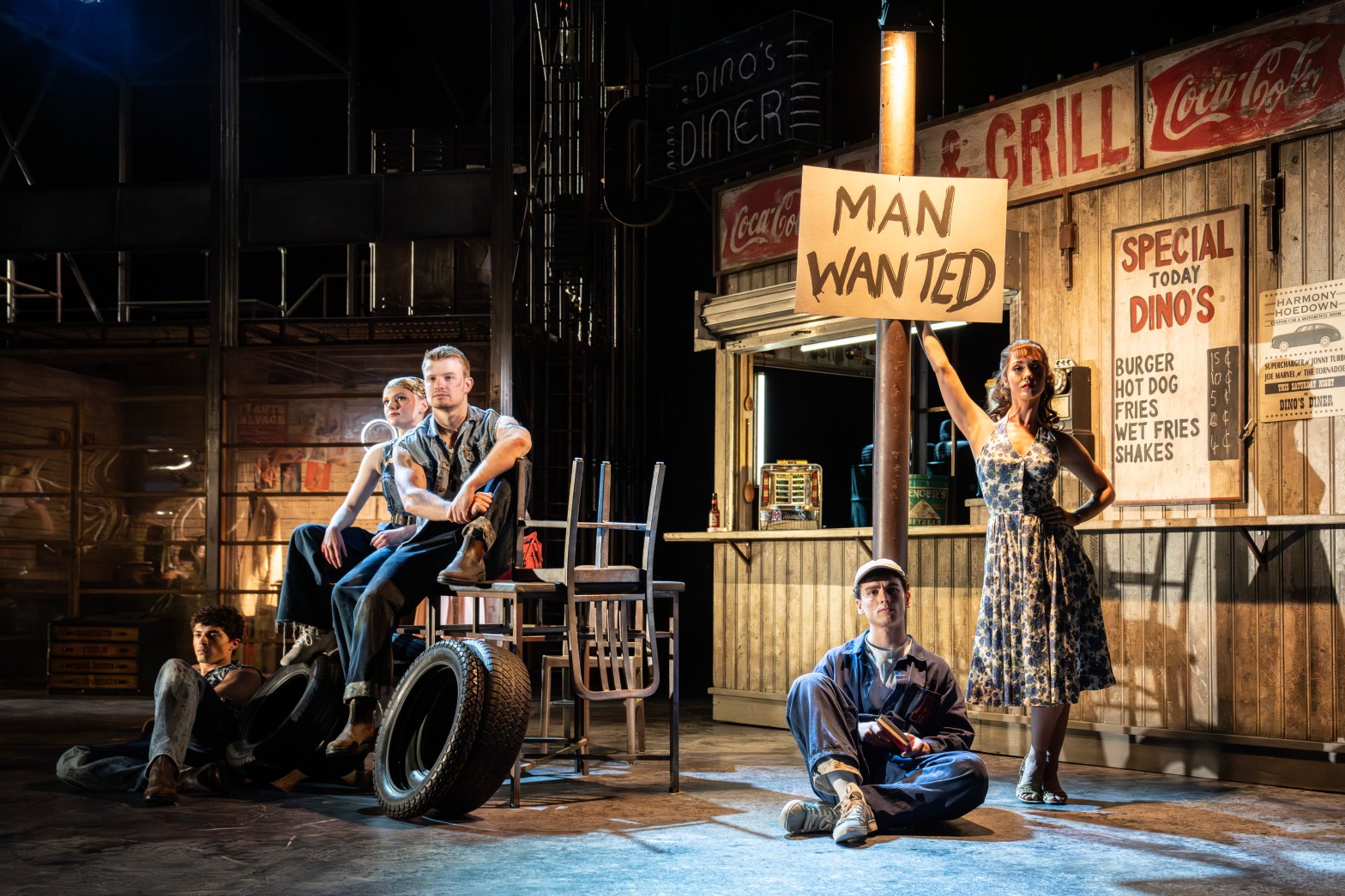
Matthew Bourne’s The Car Man arrives at The Curve with all the passion of its operatic inspiration, while transforming Bizet’s Carmen into something distinctly its own. Loosely based on the famous opera, Bourne’s reimagining retains its central themes of lust, jealousy and revenge, but relocates the action to 1950s America, where desire and violence simmer.
As the audience files into the auditorium, the cast is already on stage, inhabiting the world of the production. They mingle amongst an oil-stained garage and greasy diner, immediately immersing us in small-town America. A towering billboard welcomes visitors to the town of Harmony with a picturesque sunset scene, while details such as a 15-cent burger firmly root us in a bygone era.
At the centre of the story is Luca (Will Bozier), a charismatic drifter whose arrival disrupts the delicate balance of the community, becoming entangled with Lana (Ashley Shaw), the sultry wife of garage owner Dino (Alan Vincent), while simultaneously drawing the attention of Angelo (Leonardo McCorkindale), a gentle young man who struggles to fit into the hyper-masculine culture that surrounds him. The resulting web of attraction, betrayal and resentment drives the narrative towards its devastating finale.
Bourne’s storytelling is, as always, almost entirely through movement, and it’s incredibly effective here. The choreography leans heavily on ballet but has real bite, infused with the vigour and sensuality of tango, alongside flashes of other styles. The opening sequences are particularly striking, juxtaposing the macho physicality of the garage workers with their athletic grace, hurling tyres in one beat and landing silently in the next.
The performances throughout are exceptional. Bozier’s Luca exudes danger and charm in equal measure, while Ashley Shaw’s Lana captures both vulnerability and desire. Together they demonstrate how much can be communicated through a single look across the stage. Leonardo McCorkindale brings real tenderness to Angelo, making him one of the production’s most sympathetic figures. Anna-Maria De Freitas is particularly moving as Rita, Lana’s sister, conveying anguish and longing through remarkably expressive facial work.
The visual storytelling is equally impressive. The first act’s world of garages, diners and full-skirted dresses evokes classic Hollywood depictions of 1950s America, occasionally recalling West Side Story. Then comes a dramatic transformation after the interval. According to the programme, six months have passed, but the shift in style feels closer to a decade. Leather outfits and towering beehive hairstyles transport us into the 1960s, creating a striking contrast with the world we left behind.
The score, arranged by Terry Davies and featuring Rodion Shchedrin’s Carmen Suite after Bizet, provides the production with its relentless momentum. Driven largely by strings and percussion, the music mirrors the emotional intensity unfolding on stage.
Credit should also be given to the production’s technical departments. The lighting design works seamlessly with movement and music to illustrate the haunting consequences of the characters’ choices. Meanwhile, the make-up and props teams achieve moments of startling realism, with bruises and injuries appearing almost as if by magic before our eyes.
The final tableau is unforgettable. The cast hold their closing pose for so long that it feels as though they themselves remain stunned by the outcome, frozen in the aftermath alongside the audience.
Every movement feels purposeful, every glance loaded with meaning. The Car Man is a gripping piece of dance theatre that demonstrates why Matthew Bourne remains one of Britain’s strongest storytellers.
Running at The Curve until 20th June 2026 https://www.curveonline.co.uk/whats-on/shows/the-car-man-2/
*****
 Katie Reviews