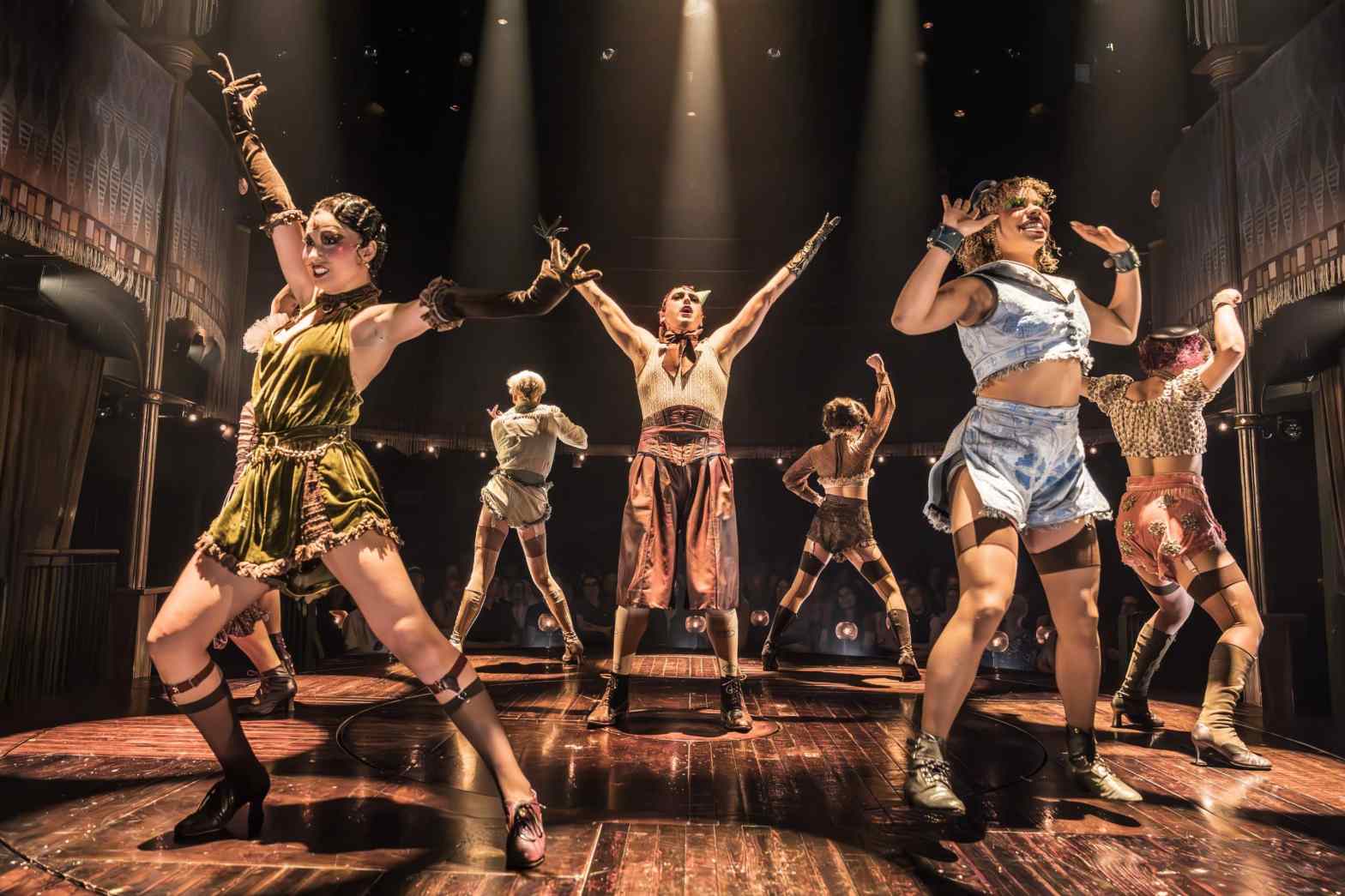
Few productions immerse an audience quite like Cabaret. Before the first line is spoken on stage, the experience has already begun. With an additional hour of pre-show entertainment, it’s impossible not to feel like you’re getting value for money, transforming a trip to the theatre into an evening spent inside the decadent world of the Kit Kat Club itself.
From the moment the doors open, the ensemble is utterly hypnotic. Even the simplest movement commands attention as musicians and dancers weave effortlessly through the audience, while crowds swirl around them, queue for drinks or take in their surroundings.
The venue itself is breathtaking. Gold-foiled ceilings, painted frescoes, and glamorous marble bars complete the illusion that you’ve stepped into 1930s Berlin. The costume design perfectly captures the club’s ambiguity: chunky leather boots paired with barely-there dresses, masculine tailoring sitting comfortably alongside exaggerated femininity. The muted palette of worn browns and greys only makes the bold blues and flushed pinks of the performers’ makeup feel even more striking, as though glamour is fighting desperately against a world slowly losing its colour.
It was disappointing not to see Joy Woods in the role of Sally Bowles, with Marina Tavolieri stepping in instead. Yet Tavolieri makes the role entirely her own. Her Sally feels gloriously unhinged from the outset, seemingly unravelling from the moment we meet her. Rather than presenting Sally’s confidence as something aspirational, she lets us see the fragility beneath it almost immediately. Her rendition of “Maybe This Time” is particularly affecting, stripped of optimism and instead filled with quiet melancholy. It’s a version that feels less like someone daring to dream, and more like someone desperately trying to convince themselves that happiness might still be possible.
Rather than the seductive puppet master we’ve seen before, Muscato’s Emcee is noticeably world-weary. His crude innuendos land with the weary timing of someone telling jokes they’ve stopped finding funny themselves, making the Kit Kat Club feel seedier and more unsettling than seductive. Frequently sitting at the edge of the stage, silently observing the action, he resembles an omniscient figure watching a tragedy he has witnessed countless times before. His presence is less ringmaster than weary prophet.
As the narrative darkens, so too does the atmosphere. By the time Ludwig’s affiliations are revealed, the entire room seems to shift. The music continues and the dancing never truly stops, but something changes almost imperceptibly. Even familiar songs take on new meaning, and by the end, the invitation to “Leave your troubles outside” no longer sounds like a promise, but a threat.
The supporting cast is equally impressive. Ruthie Henshall is superb as Fraulein Schneider, making every difficult decision feel painfully understandable. Baker Mukasa brings a gentle sincerity to Clifford Bradshaw, making him immediately likeable and grounding his relationship with Sally in genuine affection. Lucas Koch is equally compelling as Ernst Ludwig, projecting effortless charm for much of the evening before revealing the far more sinister reality beneath the surface.
The musicians are equally captivating. Their agile fingers dance across each instrument with effortless precision, weaving Kander and Ebb’s score seamlessly into the fabric of the club.
This Cabaret reminds us that beneath the glitter and glamour lies a society dancing ever closer to catastrophe. By the final curtain, the invitation to forget the outside world has curdled into something far darker, and it lingers long after leaving the theatre.
*****

